The making of a periodical
The Calcutta office, a printer’s name and a library’s marks. Small details anchor the journal in a physical world.
Explore the imprint ↗The heritage projectResourcesPeriodical archive
Two historical journal volumes, preserved as source material for the study of the Aguri community.
Ugrakshatriya-Pratinidhi — উগ্রক্ষত্রিয়-প্রতিনিধি, “The Ugrakshatriya Representative” — is one of the historical sources used in researching Aguri heritage. Its pages document some of the community’s nineteenth-century public discussions. These two bound volumes come from the owner’s collection. Their original scans are preserved, including library stamps, damaged edges and annotations.[1][2]
A few places to begin
The Calcutta office, a printer’s name and a library’s marks. Small details anchor the journal in a physical world.
Explore the imprint ↗Electricity, poetry, an association, a press company and responses to social essays appear in one contents list.
Explore the contents ↗A science essay begins with a language problem: how to explain unfamiliar ideas to Bengali readers.
Read the complete English translation ↗The second year opens with reflections on publication, difficulty and the hope of continuing.
Read the complete English translation ↗The digital reading room
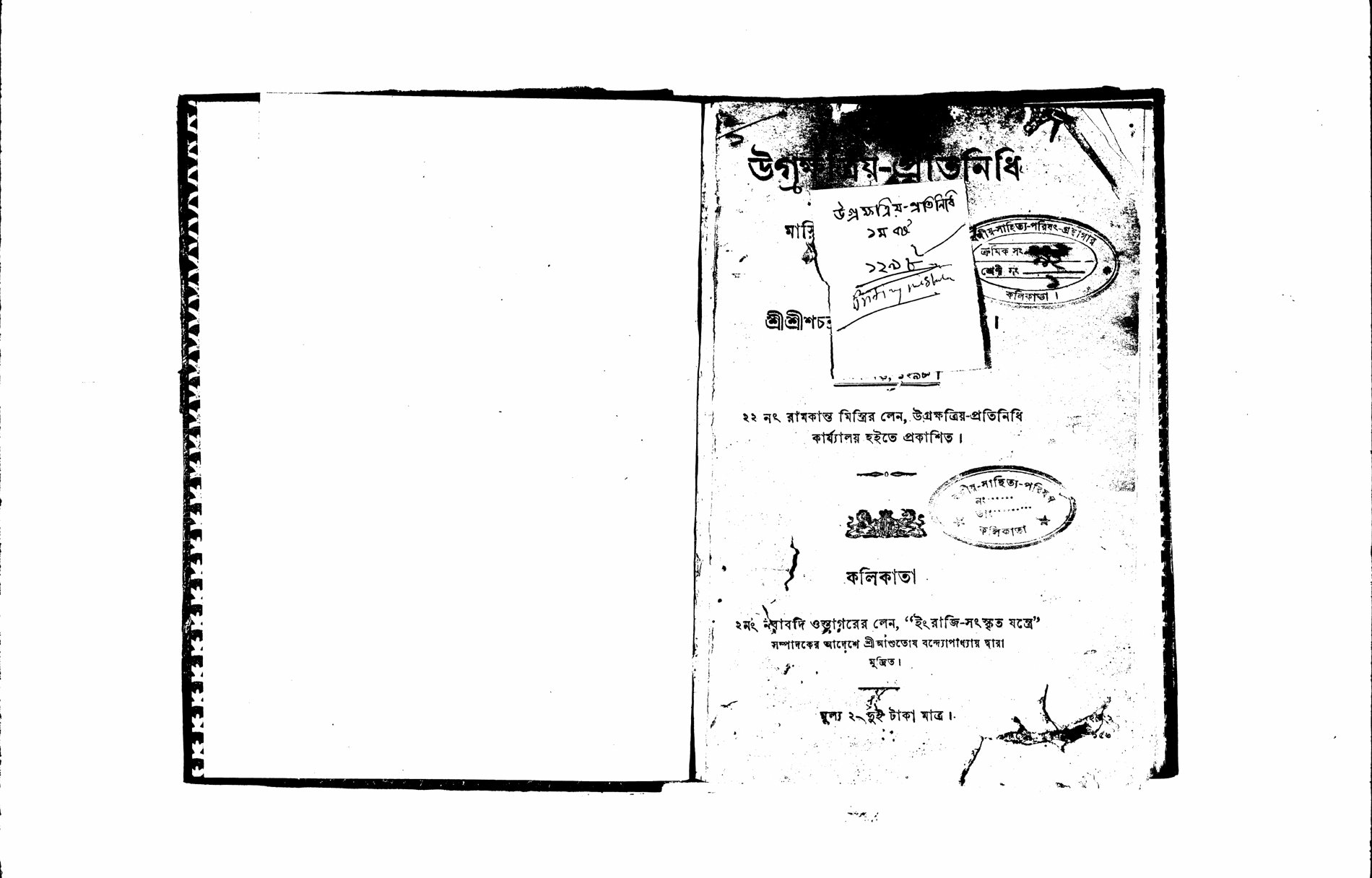
Original scan · Select the image to enlarge it.
One scan usually contains two printed pages.
Selected scans have short English reading notes and links to the longer English translations. Each translation specifies the original pages included.
Letters, names, numbers and column order may be wrong. Consult the image before quoting. Missing search results do not prove a word is absent.
Bengali search uses unreviewed OCR. English search covers selected reading notes.
Scan numbers identify images inside the PDF. Printed page numbers belong to the journal and can be interrupted by covers or inserts. The reader uses scan numbers so a reference always opens the same image.
English reading notes distinguish a translated heading, a selected passage and an editorial paraphrase. Bengali OCR is machine-generated text for discovery; it has not been approved as a transcription. Damaged type, binding shadows and the printed columns require comparison with the image.
Dates: 1298 Bangabda spans parts of 1891 and 1892; 1299 spans 1892 and 1893. The journal’s early headers include Baishakh 1298, corresponding approximately to April–May 1891. A year label should not be mistaken for a complete issue catalogue.[1][2]
The first volume’s contents records the following writers and contributions. These are credits in a publication; they do not independently establish the contributors’ caste, family relationships or full biographies.[1]
Listed with an M.A. beside Tadit (“Electricity”), beginning on printed p. 12. His essay opens with the challenge of scientific writing in Bengali.
Read the opening ↗Named beside Ami Ke? (“Who am I?”) and Ke Bara? (“Who is great?”) in the contents. These titles are translated as reading aids.
See the contents ↗One of the names listed alongside Ugrakshatriya Samiti. The credit establishes a connection with this contribution; the exact division of authorship needs the articles themselves.
See the printed credit ↗The Volume I imprint names him as printer, acting on the editor’s instruction. This corrects the earlier translation’s reading of the name as “Shrimatosh.”
See the imprint ↗The earlier translation assigned the surname “Nandi” to a contributor named Haridas. The contents scan does not support that reading securely; his English surname is withheld until another clear occurrence can be checked.
Read further