Origins, land, social change and the community’s place in Bengal’s history.
Aguri history is closely connected with the land and society of western Bengal. Questions of ancestry, cultivation, community organisation and public life run through its story.
This page explores the community’s origin traditions and historical setting, drawing on Bengali literature, regional histories, community books, scholarship and periodicals. Each source contributes a perspective to a history that continues to be researched.
Origins: traditions and interpretations
Origin narratives are part of heritage in their own right. The question is what kind of evidence supports each account, and how much it can establish.
Textual identification · genealogy unproven
The name Ugra Kshatriya
Risley records a popular identification of the Aguri with the Ugra category in the Manusmriti. That is evidence that the identification circulated in his time. A category in a Sanskrit legal text is not, on its own, a demonstrated family history of a Bengali community.[1]
Historical interpretation · contested
The Sadgop–Khatri account
Oldham’s account connects Aguri origins with Sadgop and Khatri marriage alliances. McLane is reported to question its chronology using the literary record. Until the underlying passages have been checked together, this site treats the account as debated, rather than labelling it conclusively proved or disproved.[2][3]
Origin tradition · discussed by Bandhu
Stories of migration from Agra
In Chapter Four, Bandhu records a claim, attributed to Panchanan Tarkaratna, that the community came from Agra with Raja Man Singh’s army and took its name from that place. Bandhu rejects this explanation as conjectural, arguing for an earlier presence in Bengal and deriving the name instead from agrahari. This records a debate within community history; Tarkaratna’s underlying passage still needs direct comparison.[4]
Community history · Haricharan Bandhu, 1940
Rajput service, land grants and settlement in Rarh
In Rajput O Ugrakshatriya, Bandhu argues that Rajput warriors who entered military service in Bengal became landholders in Rarh. He derives Agari or Aguri from agrahari, a holder of royal land grants, using his reading of the Mallasarul copperplate. He also proposes connections between Ugra Kshatriya lineages and the Pala and Sena kings. These are the author’s historical arguments; the inscription and the proposed genealogy are distinct questions.[4]Read his account in English, especially Chapters Four, Five and Nine.
Landmarks in community history
Literary lead · indirect citation
A name in Bengali literature
McLane’s discussion of the Aguri refers to Mukundaram Chakrabarti’s Chandimangal. The often repeated date of 1589 comes to this project through a secondary citation. The relevant edition and passage still need checking; it is not a community foundation date.[3][2]
Regional context
The rise of the Burdwan Raj
The district administration dates Abu Rai’s appointment as kotwal and chowdhury at Burdwan to 1657. This helps frame later accounts linking the community with the Raj; it does not establish those accounts of descent.[5]
Original historical text
An outside description
Risley’s The Tribes and Castes of Bengal describes the Aguri as cultivators and traders and records subdivisions, ritual practices and landholding. Its classifications belong to the colonial world in which it was written.[1]
Community organisation & learning
Education and public discussion
Writing under the Ugra Kshatriya name records interest in community history, association work, education and social questions. The periodical Ugrakshatriya-Pratinidhi is one surviving source for this activity.[6][7]
Bengali literary periodical
A community history reviewed in Prabasi
The Magh 1321 issue reviews Rajput O Ugrakshatriya, showing that a book about the community’s origins and customs was reaching a wider Bengali reading public.[8]
Bengali historical book
A revised account of origins
The second edition of Haricharan Bandhu’s Rajput O Ugrakshatriya brings inscription-based arguments into its account of community history.[4]
Agrarian politics
Land reform and public life
Hare Krishna Konar became minister for land and land revenue in West Bengal’s United Front government. His work connects an Aguri public figure’s life with the state’s wider history of peasant organisation and land reform.[9]Read his biography.
National public service
From Bengal to Parliament
Ajit Kumar Panja entered the Lok Sabha after a career in the West Bengal Assembly and state government. He later held several Union ministerial responsibilities.[10][11]Read his biography.
Writing community history in Bengali
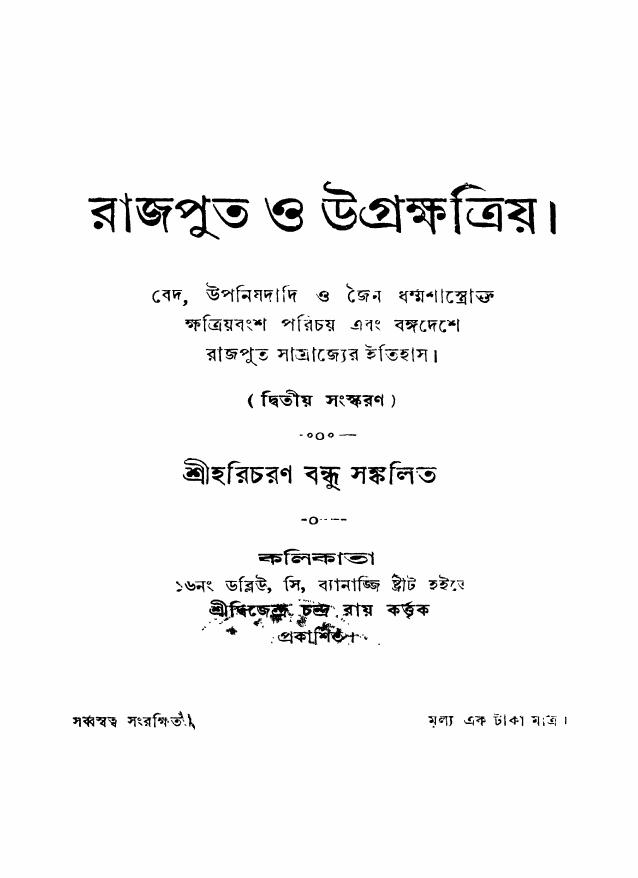
Second-edition title leaf. Digital Library of India scan, from the Bangiya Sahitya Parishad collection.
An original Bengali voice
রাজপুত ও উগ্রক্ষত্রিয় Rajputs and Ugra Kshatriyas
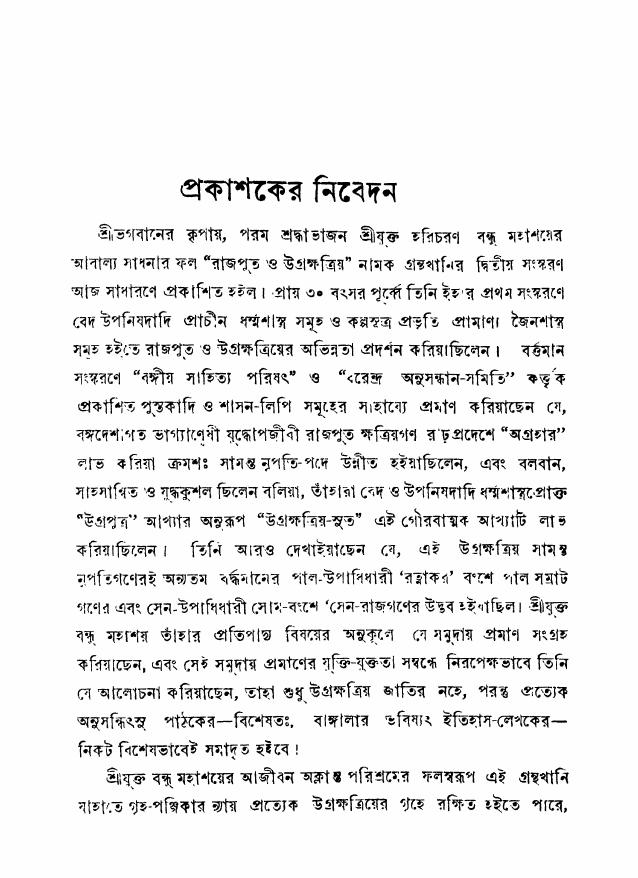
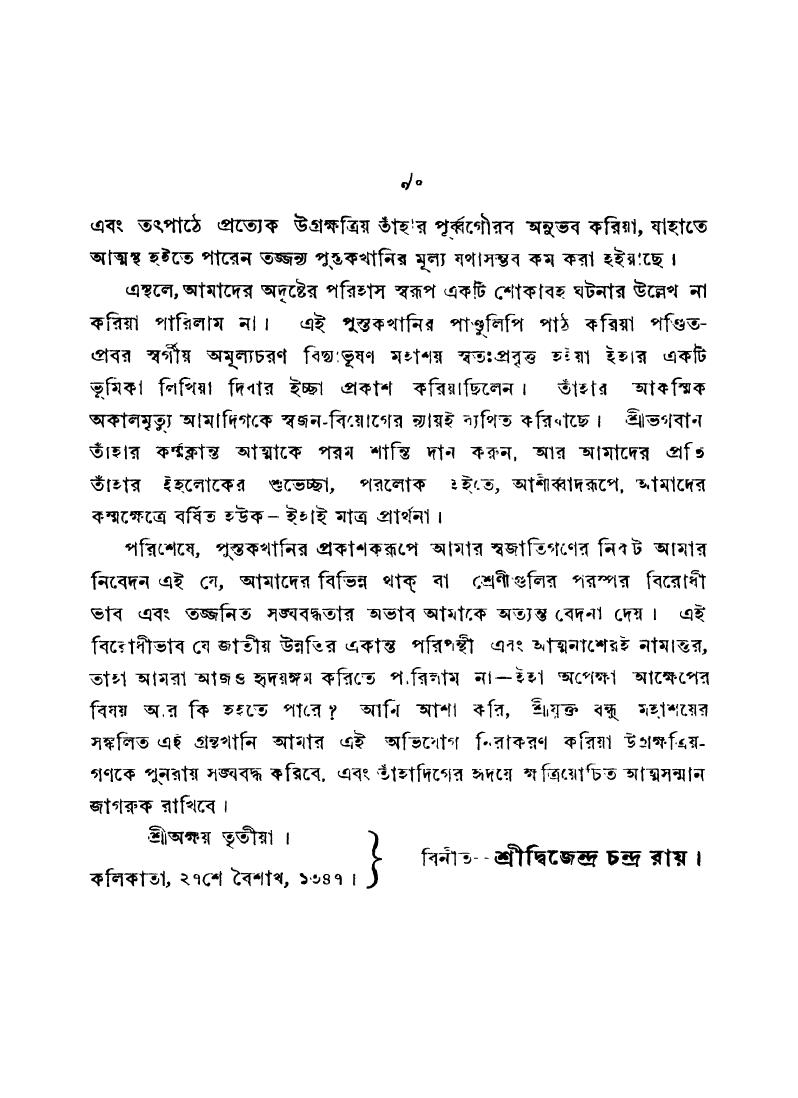
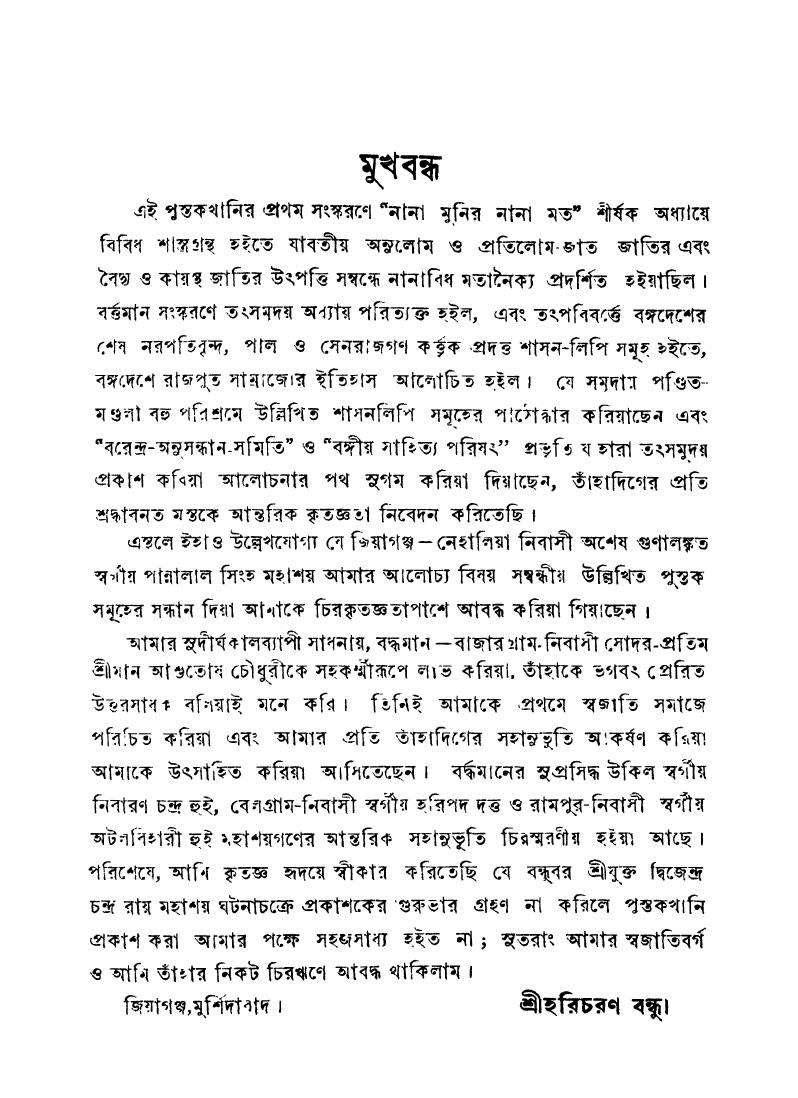
In his 1940 foreword, Haricharan Bandhu explains that he replaced an earlier chapter with discussion of inscriptions issued by the Pala and Sena rulers, published through the Varendra Anusandhan Samiti and Bangiya Sahitya Parishad. His publisher, Dwijendra Chandra Ray, also appeals for unity within the community.[4]
These opening pages show how the author presented his historical argument. His proposed Rajput ancestry remains an interpretation to examine alongside other evidence.
A much earlier review in Prabasi, printed on pp. 470–471 in Magh 1321 (1915), describes the book’s treatment of origins and customs. The reviewer also asks why its foreword was in English—an intriguing detail about the languages used to address readers. This review concerns an earlier edition; it should not be confused with the revised 1940 volume.[8]Read the complete review in English ↗
Read colonial accounts in context
Risley’s entry combines observations about agriculture and social organisation with a theory about scriptural origins and hostile claims about temperament. These are different kinds of statement. The website uses the record to study historical representation, and rejects the idea that an inherited community identity determines a person’s character.[1]
The journal offers another vantage point: writers discussing institutions, learning and the practical work of publication. A SAGE-published study of Burdwan’s rice trade includes Ugra Kshatriya Pratinidhi, 1298 BY, in its bibliography, confirming its place in the research record.[12]
What remains open
The exact Chandimangal passage and the dating of the edition used by McLane.
How the community’s own origin accounts changed across generations and publications.
How families, landholding, commerce and education intersected in particular villages.
How schools, associations and public figures shaped community life across different generations.
A useful distinctionAn early written mention tells us that a name was in use by that point. It does not tell us when a community first formed, or prove a single origin for all its families.
হরিচরণ বন্ধু, রাজপুত ও উগ্রক্ষত্রিয় — Rajput O Ugrakshatriya, second edition (1940). English reading translation of the dedication, prefaces, all nine chapters and surviving conclusion available as a 98-page PDF, with original errata sheets and a translator’s note. Printed pages 142–143 are missing from the digitised original. Uncertain readings are marked; this is not a fully verified scholarly edition. Separate preface readings include Bengali transcriptions and source images. Source details
Ugrakshatriya-Pratinidhi, Volume I (1298 Bangabda). Owner-supplied PDF. Complete electricity essay (printed pp. 12–23) and first editorial’s opening-page extract translated against the scans; selected reading notes also available. Bengali OCR remains unreviewed. Source details