The heritage projectHistoryOrigins
From Nagadee to Jotedar: The Burdwan Raj and the Origins of the Aguris
An argument about military service, landholding and identity in the history of the Aguris and the Burdwan Raj.
The Aguris appear to descend from the Nagadee forces, the cash-paid army the Burdwan Raj raised and maintained during the 18th century as a reaction to certain external threats from other principalities and the Maratha Bargi raids. As the East India Company wound that army down between 1763 and 1809, its soldiers turned to the land and, within a century, became the dominant landholders of Burdwan.
The argument in brief
Six points tie the Aguris to the Burdwan Raj's army rather than to an ancient pedigree.
- A Burdwan community. In 1872–1921, 73–87 per cent of Bengal's Aguris lived in Burdwan district, the Raj's heartland, not across Bengal as settlers from a Mughal provincial army would.
- Descended from the Nagadees. After 1696 the Raj raised an army paid in cash, not land: hired soldiers without local holdings. Regional histories describe the Nagadees as largely Aguri.
- A Rajput link. A section of the Aguris took the sacred thread at marriage, as the Rajputs of Bihar did and Bihar's Bhumihars did not.
- Soldiers turned landholders. As the army was wound down, military service became jotes, and jotes became jotedar dominance.
- The Chandimangal couplet proves nothing earlier. Its standard edition rests on a manuscript dated 1700, and its Aghari is only assumed to mean the Aguris.
- "Ugra Kshatriya" is late. It is attested from the 1870s, became official in 1931, and has no demonstrated link to earlier Sanskrit references to Ugra.
Timeline
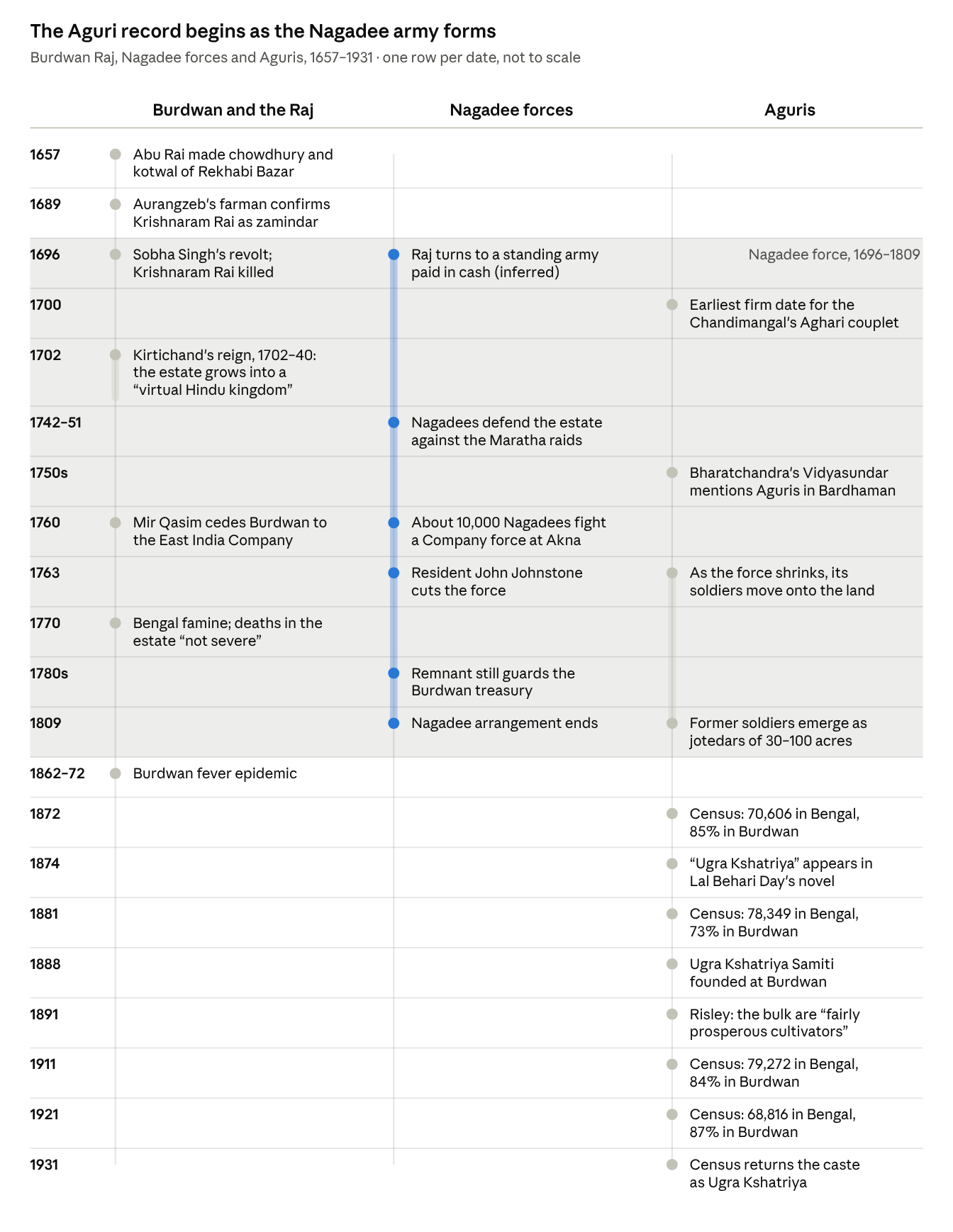
Read the timeline as text
Nagadee force, 1696–1809
| Date | Burdwan and the Raj | Nagadee forces | Aguris |
|---|---|---|---|
| 1657 | Abu Rai made chowdhury and kotwal of Rekhabi Bazar | ||
| 1689 | Aurangzeb’s farman confirms Krishnaram Rai as zamindar | ||
| 1696 | Sobha Singh’s revolt; Krishnaram Rai killed | Raj turns to a standing army paid in cash (inferred) | |
| 1700 | Earliest firm date for the Chandimangal’s Aghari couplet | ||
| 1702 | Kirtichand’s reign, 1702–40: the estate grows into a “virtual Hindu kingdom” | ||
| 1742–51 | Nagadees defend the estate against the Maratha raids | ||
| 1750s | Bharatchandra’s Vidyasundar mentions Aguris in Bardhaman | ||
| 1760 | Mir Qasim cedes Burdwan to the East India Company | About 10,000 Nagadees fight a Company force at Akna | |
| 1763 | Resident John Johnstone cuts the force | As the force shrinks, its soldiers move onto the land | |
| 1770 | Bengal famine; deaths in the estate “not severe” | ||
| 1780s | Remnant still guards the Burdwan treasury | ||
| 1809 | Nagadee arrangement ends | Former soldiers emerge as jotedars of 30–100 acres | |
| 1862–72 | Burdwan fever epidemic | ||
| 1872 | Census: 70,606 in Bengal, 85% in Burdwan | ||
| 1874 | “Ugra Kshatriya” appears in Lal Behari Day’s novel | ||
| 1881 | Census: 78,349 in Bengal, 73% in Burdwan | ||
| 1888 | Ugra Kshatriya Samiti founded at Burdwan | ||
| 1891 | Risley: the bulk are “fairly prosperous cultivators” | ||
| 1911 | Census: 79,272 in Bengal, 84% in Burdwan | ||
| 1921 | Census: 68,816 in Bengal, 87% in Burdwan | ||
| 1931 | Census returns the caste as Ugra Kshatriya |
Every firmly dated Aguri record falls after the 1696 revolt that, on this article's reading, created the Nagadee force. The shaded band marks the force's life, to 1809.
1. The Burdwan Raj and the founding of the Nagadee forces
The Raj was built by the Kapoors, Punjabi Khatris from Lahore. Sangam Rai settled near Burdwan as a trader; in 1657 Abu Rai became chowdhury and kotwal of Rekhabi Bazar; and in 1689 Aurangzeb's farman confirmed Krishnaram Rai as zamindar of pargana Burdwan (Wikipedia; Purba Bardhaman district). The farman also authorised him to raise an army (McLane 1993).
In 1696 Sobha Singh, zamindar of Chitua and Barda, rebelled. Krishnaram Rai was killed in battle, his family captured (Wikipedia) and his palace seized (McLane 1993). The Raj's troops had failed to protect the Raja. This article treats the revolt as the moment the Raj chose a standing army paid in cash from its treasury and answerable to the ruler alone. The Nagadee forces were the Raj's answer to the disaster of 1696.
Under Kirtichand (r. 1702–1740) the estate grew into what John McLane calls "a virtual Hindu kingdom within the weakening provincial Mughal hegemony" (McLane 1993, ch. 6), absorbing the Sadgop lordship of Gopbhum in the 1740s. The Nagadees defended it against the Maratha raids of 1742–1751 (McLane 1993). In 1760 Mir Qasim ceded Burdwan to the East India Company, and Maharaja Tilakchand's army fought its last battle.
2. A cash army of hired men
The Nagadees were paid in cash because they had no land to serve from.
Nagadee (also nagdee, nagdi) comes from nagad, cash. Bengal's older retainers served in return for land (jagir, chakran); the Nagadees drew salaries from the Maharaja's treasury. Their upkeep exceeded Rs 3 lakh a year, and about 10,000 Nagadee infantry fought a Company force under Martin White in 1760 (Halder 1982 and the Burdwan settlement report of 1940, cited in Dutta 2023, pp. 299–300). The battle was fought at Akna on 29 December 1760 (Firminger 1917).
This article reads the cash pay as the mark of hired outsiders with no local holdings, and the Aguris as their descendants. Dutta's sources call the Ugra Kshatriyas "the bulk of the nagdees" (p. 299): on this reading, the soldiers whose descendants became the Aguris. The force had an up-country core of Rajputs, Bhumihars, Pathans and Afghans (Chatterjee 1986). Up-country recruits were familiar in eighteenth-century Bengal: hired matchlockmen were called Buxarries, "natives of Buxar" in Bihar, and Clive raised 200 of them in 1757 ("Buxerry", dictionary entry).
3. A Rajput link: the thread at marriage
One Aguri custom points to the Rajputs of Bihar and eastern UP. In 1891 Risley found that a section of the Aguris took the sacred thread at marriage rather than in childhood (vol. I, p. 12). Bhorjpuri Rajputs did the same: they "shuffle on the janeo in a rough-and-ready fashion when a boy gets married" (vol. II, p. 191).
The shared custom links part of the Aguri community with the Rajputs of the Bhojpuri belt of Bihar and eastern Uttar Pradesh, the country that gave Bengal its "Buxarries". It is a pointer rather than proof of descent: Orissa's Khandaits, Palamau's Cheros and some Marathas also took the thread at marriage, a practice Risley calls common among castes "pressing to be counted among the number of the twice-born" (vol. I, p. 464).
4. From soldiers to landholders
The Company ran the Nagadees down over half a century, and their soldiers moved onto the land.
John Johnstone, the first Company Resident at Burdwan, cut the force in 1763. The rest policed robber bands from the Birbhum and Bankura jungles and still guarded the Burdwan treasury in the 1780s; the arrangement ended in 1809 (Halder 1982 and the settlement report, pp. 22–23, cited in Dutta 2023, p. 300). Other accounts describe a sudden disbandment (McLane 1993; Firminger 1917) and, without a source, a planned settlement of soldiers on frontier jotes; the regional sources describe gradual cuts and land acquired "through various means, including deception and trickery" (Dutta 2023, p. 300).
Many former Nagadee soldiers of the Aguri community joined a new stratum of powerful peasants, each holding 30 to 100 acres (Dutta 2023, p. 307, citing Halder 1982). By 1891 Risley found that "many of them hold estates and tenures of various grades, and the bulk of the caste are fairly prosperous cultivators" (vol. I, p. 13). The tie to the Raj endured. At Kshiragram, where Ugra Kshatriyas held the larger part of the land, each of their nine lineages sent a representative to the rituals of a temple rebuilt around 1730 under Maharaja Kirtichand and run from the Raj's temple office (Togawa 1996, ch. 1).
Do the numbers add up? They do if settlement began soon after 1696. The projection below starts in 1700 and grows the community year by year. It assumes wives aged 15–24 at settlement and a life expectancy of 25.5, Davis's figure for Indian women in 1872–91. It adds extra deaths for the Maratha raids (5%), the 1770 famine (5%; famine deaths in the Burdwan estate were "not severe") and the Burdwan fever of 1862–72 (10%).
| Couples settling, 1700 | Births per woman | Natural increase | Aguris projected, 1872 | Aguris counted, 1872 |
|---|---|---|---|---|
| 8,000 | 5.7 | 0.8% a year | 70,100 | 70,606 in Bengal; 59,887 in Burdwan |
The rates are realistic: India's natural increase in 1881–91 was 0.8% a year, from about 49 births and 41 deaths per 1,000 (Davis 1944, p. 262). At that rate about 8,000 settling couples reproduce the 1872 count: four-fifths of a force the size recorded in 1760, leaving room for men who went home. The model assumes a single founding group and ignores later recruits.
5. Why Burdwan matters
Aguris are concentrated where the Burdwan Raj ruled.
| Year | Aguris in Bengal | In Burdwan district | Share |
|---|---|---|---|
| 1872 | 70,606 | 59,887 | 85% |
| 1881 | 78,349 | 57,272 | 73% |
| 1911 | 79,272 | 66,551 | 84% |
| 1921 | 68,816 | 59,949 | 87% |
Census figures as tabulated in Dutta 2023, Table 13.1; Risley's 1872–81 table shows the same pattern (vol. I, p. 13). Most of the rest lived in neighbouring Bankura.
Theories set aside.
- Migration with Man Singh. A tradition brings the Aguris with Man Singh's Mughal army (Bhaumik 2023, p. 48). Man Singh, subahdar of Bengal from 1595 to 1606, campaigned from Orissa to Dhaka (Wikipedia). His soldiers would have settled across Bengal, not in one district that became an estate's heartland half a century later, and no record of a local settlement exists.
- Khatri–Sadgop unions. W. B. Oldham's 1891 theory (summarised in Bhattacharya 1896, p. 156) rests on unrecorded "admissions".
6. The Chandimangal couplet
The couplet cited for a sixteenth-century Aguri presence is firmly dated only to about 1700.
Mukundaram's Chandimangal, composed in the later sixteenth century, contains a couplet Dutta quotes as Aghari nibase pure / apnar brtti kare / anuchit na kare kakhano: "the Aghari dwell in the town, follow their own calling, and never do wrong". He cites Sukumar Sen's edition, pp. 82 and 135 (Dutta 2023, pp. 301, 319). McLane uses the poem, dated 1589, to argue that Aguris were present "almost certainly" before the Khatris (McLane 1993, p. 157, via Wikipedia).
Two points undercut that use. Sen's edition "was based on a manuscript dated 1700" (Famine & Dearth project), so the couplet is firmly attested only from about 1700. And the word is Aghari, which Bhattacharya knew as the name of a separate people of Chota Nagpur and the Central Provinces (1896, p. 157); reading it as the Burdwan Aguris is an assumption.
Sen is also said to have found the couplet missing from the oldest manuscripts and added in eighteenth-century Burdwan copies to flatter Aguri patrons (Famine & Dearth project; Chettry 2022). Neither the project's translation page nor Chettry's abstract mentions this; Sen's notes on the manuscripts would settle it. The next mention, in Bharatchandra's Vidyasundar (1750s), is set in Bardhaman itself (Bhaumik 2023, p. 48).
7. A late name: Aguri to Ugra Kshatriya
"Ugra Kshatriya" is a late-nineteenth-century claim that became official in 1931.
| Date | Evidence |
|---|---|
| 1874–78 | Lal Behari Day's novel of Burdwan village life calls its hero's family Ugra Kshatriya, or Aguri |
| 1888 | Ugra Kshatriya Samiti founded at Burdwan (Dutta 2023, p. 311) |
| 1890–91 | Tarkaratna's Ugrakshetriya-vivarana; the journal Ugrakshatriya Pratinidhi begins |
| 1891 | Risley: Aguris "popularly believed" to be Manu's Ugra; the census lists "Aguri (Western Bengal)" among cultivating castes |
| 1896 | Bhattacharya: Aguris "claim to be" Manu's Ugra Kshatriya |
| 1931 | The census returns the caste as Ugra Kshatriya after it objected to "Aguri" (Dutta 2023, p. 317) |
Manu's Ugra is a legal category, not a Bengali community, and the Puranic "Ugra or Agari" that Dutta notes (p. 301) is tied to no place. The link to the Aguris appears only as the community pressed its Kshatriya claim.
Sources
Primary and early sources
- Risley, H. H. The Tribes and Castes of Bengal, vols I–II. Calcutta, 1891. vol. I; vol. II
- Bhattacharya, J. N. Hindu Castes and Sects. Calcutta, 1896. GIPE scan
- Census of India 1961, vol. XVI, part V-A(i), appendix, p. xxxiv (the 1891 classification). censusindia.gov.in
- Day, Lal Behari. Bengal Peasant Life (1878; first published as Govinda Samanta, 1874), 1916 reprint. archive.org
- Ugrakshatriya Pratinidhi, from 1891. FID4SA record
- Tarkaratna, Panchanan. Ugrakshetriya-vivarana. Calcutta, 1890 (British Museum catalogue of Bengali books).
- Mukundaram, Chandimangal, ed. Sukumar Sen (Sahitya Akademi). Famine & Dearth project, University of Exeter: "Translation Chandimangal" and Bengali text.
- Firminger, W. K., ed. The Fifth Report from the Select Committee of the House of Commons on the Affairs of the East India Company, 28 July 1812. Calcutta: R. Cambray & Co., 1917.
- Oldham, W. B. Some Historical and Ethnical Aspects of the Burdwan District. Calcutta: Bengal Secretariat Press, 1891.
Scholarship
- McLane, J. R. Land and Local Kingship in Eighteenth-Century Bengal. Cambridge University Press, 1993. DOI
- Dutta, A. K. "Prosperity, Dominance, and Social Mobility." In Explorations in Colonial Bengal, 297–324. Orient BlackSwan, 2023. Used for Halder (1982), the Burdwan settlement report (Hill and Banerjee 1940), Mitra (1953) and the 1921 and 1931 censuses, none yet examined directly. Orient BlackSwan
- Bhaumik, S. The Changing World of Caste and Hierarchy in Bengal. Routledge, 2023. Routledge
- Togawa, M. A Sakta-Pitha in Bengal. PhD thesis, University of North Bengal, 1996. NBU repository
- Chatterjee, Gouripada. Midnapore, the Forerunner of India's Freedom Struggle. Mittal Publications, 1986.
- Chettry, Aniket Tathagata. "The Textual Representation of Kingship and Authority in the Chandimangal of Mukunda Chakroborty." The Medieval History Journal 25, no. 1 (2022). SAGE
- Davis, Kingsley. "Demographic Fact and Policy in India." Milbank Memorial Fund Quarterly 22, no. 3 (1944), p. 262. PDF
- Life expectancy in high-mortality populations, citing Davis (1951), Max Planck Institute for Demographic Research. Table
Reference
- Wikipedia: "Bardhaman Raj", "Aguri (caste)", "Gopbhum", "Man Singh I", "Maratha invasions of Bengal", "Great Bengal famine of 1770".
- Purba Bardhaman district, "History"; "Buxerry", dictionary entry quoting Clive (1757).