The publisher’s appeal
Dwijendra Chandra Ray introduces the revised edition, remembers those who helped it appear, and appeals for unity within the community.
Read the English translation →The heritage projectResourcesHistorical book
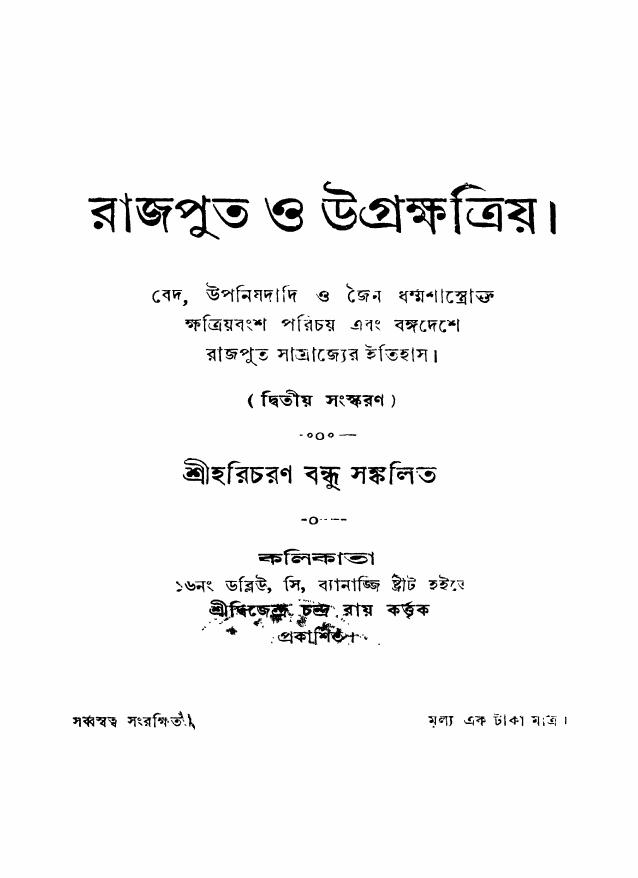
Haricharan Bandhu’s historical book, second edition, 1940: read the English translation and the Bengali original.
Historical book · Now available in English
Rajputs and Ugra Kshatriyas
Read this resource for Aguri / Ugra Kshatriya history in English or consult the Bengali original. Bandhu develops an argument connecting the community with Rajput ancestry, drawing on historical texts and inscriptions. His interpretation can be read alongside the other sources gathered on this website.[1]
Achintya Kumar Dutta discusses the 1913 edition in his study of community organisation and claims to Kshatriya recognition (2023, p. 315). That reference concerns an earlier edition than the revised 1940 text translated here. Read how the book fits into the wider history of community identity.[2]
The translation covers all nine chapters and the surviving conclusion. Two printed pages, 142–143, are missing from the digitised Bengali copy; the gap is marked in the translation.
English reading edition
The PDF includes the dedication, publisher’s appeal, author’s foreword, nine chapters, surviving conclusion and an appendix with the original errata sheets. A translator’s note closes the document. Uncertain readings are identified in the text; this is a reading translation, not a fully verified scholarly edition.
Choose a section to open it in the PDF. Numbers below refer to the English edition.
Dwijendra Chandra Ray introduces the revised edition, remembers those who helped it appear, and appeals for unity within the community.
Read the English translation →Haricharan Bandhu explains the revised book’s approach to inscriptions and acknowledges the scholars and supporters who assisted him.
Read the English translation →Both translations include Bengali transcriptions and original page images.
The original digitised copy is preserved with its library marks and pagination. Printed pages 142–143 are absent from this scan.
Prabasi reviewed a book of this title in Magh 1321 (1915), before the revised edition shown here. The review’s printed surname differs from the 1940 title leaf; that discrepancy is recorded with the translation. Read the review in English.[3]
The title page, publisher’s note and author’s foreword were checked against the scan. The full PDF retains the original pagination and library marks. The Digital Library of India record identifies the work as public domain. View the source catalogue record.[1]
For an overview of the community’s past, visit History. For other books and research material, explore Resources.
Read further