An independent community heritage project

The heritage projectPeopleDasarathi Tah

Dasarathi Tah

Dasarathi Tah joined the Congress in 1930 and participated in the Salt Satyagraha and Quit India movements.

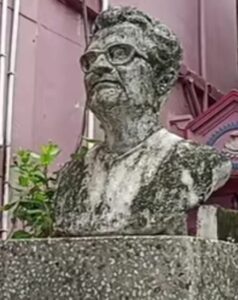
A commemorative bust of Dasarathi Tah, wearing glasses
Commemorative bust of Dasarathi Tah. Photograph published with Krishaksetu News’s account of his life, 15 August 2026. Image rights remain with their respective holder.

Freedom movement · Journalism · Public service

Life and work

1911–1980 · Freedom fighter, editor and legislator

Dasarathi Tah joined the Congress in 1930 and participated in the Salt Satyagraha and Quit India movements. His later political career included representing Raina in the West Bengal Assembly in the first general election after independence, and again in 1957 and 1967, first with the Kisan Mazdoor Praja Party and later the Praja Socialist Party.[1]

Journalism was another lasting part of his work. He edited and published Damodar, which began as a weekly before independence and later became a daily. A Bengali local-history account also remembers his wife, freedom fighter Roma Tah, keeping the paper running while he worked underground. Their story connects the region’s freedom movement with the practical work of sustaining a newspaper.[1][2]

Achintya Kumar Dutta includes him in his discussion of Ugra Kshatriya figures in Explorations in Colonial Bengal (2023), p. 314. Spellings of names vary between publications.[3]

Explore all featured personalities →

How the collection was selected

Read further

Notes & sources

  1. Dasarathi Tah — Wikipedia. Article read directly; the cited biographical dictionary passage has not been independently checked. Source details
  2. Krishna Saha, Bengali account of freedom fighter Dasarathi Tah — Krishak Setu. Bengali article consulted 13 September 2026. This local-history account is explicitly attributed; dramatic wartime claims are not repeated without corroboration. Source details
  3. Achintya Kumar Dutta, “Prosperity, Dominance, and Social Mobility: Emergence of a Mobile Caste in Colonial Southwest Bengal” (2023), pp. 297–324. Complete chapter, including endnotes and references, read directly in the supplied book. Page references use its printed pagination. Origin hypotheses remain attributed to the author. Link opens the publisher’s book record. Source details

Search the heritage project

Enter a word or phrase to begin.

For Bengali text inside the journals, use the journal reader.